
Modal Tension Points
Boiling down everything in music to three notes.

Simplifying a Bigger Picture
The concept of modes has a seemingly endless supply of learning resources. In my last article “Modal Progressions”, we took a deep dive into how the order of chords from various modes can help us break out of the tried and true seven chord per scale format. In this way we can take a main scale and overlap other scales onto it as long as the first note never changes. Some overlaps worked better than others with reasons for why these overlaps operate the way they do. The end result gave us three broad rules to use. (1) Major modes easily overlap with the Major Scale, (2) Minor Modes easily overlap with the Natural Minor Scale, and (3) each major mode has a parallel minor mode that blends well with it.
Today I want to take that big concept and add another layer to it that will actually simplify your playing. The goal here is to map two notes related to a concept called Functional Harmony to connect to a Tonic note. The Tonic note can start a major or minor chord, scale, modes, etc. By using two notes to guide our ears to a single note, we can literally build sonic ideas off of this one Tonic note. The trick is to know the roles of these two notes and where to find them.
Its All About Lydian and Locrian
Here’s a quick recap on Functional Harmony.
A Tonic Function occurs as long as the 4th degree of the main scale is NOT used. Tonic Function simply means “at rest”, while THE Tonic is the “1st degree note of a scale”.
A Pre-Dominant Function can be used when the 4th degree of the scale is used, but the 7th degree of the scale is NOT used. The 4th degree creates a sense of “movement”.
A Dominant Function occurs when both the 4th and 7th degrees are used. While the 4th degree creates “movement”, the 7th degree “points us to a Tonic note”. We can use the 7th degree in a Tonic Function and remain “at rest” because the 7th degree is just “pointing to” where we are in a restful state. Combining the 4th and 7th degrees “points and moves” us toward a Tonic.
Below we have the Major Scale in terms of degrees, modes, and tetra-chords (4 note chords). Each degree is a whole step apart from the next except for degree 3 with 4 and 7 with 1. Those two points have half-steps.
When we think about the 4th and 7th degrees helping us to control tension, we can also use them a a guide to find the Tonic. Using the 7th degree, we can see that the Major Tonic is a half-step above it (7 to 1). The Minor Tonic is also found using the 7th degree by moving down a whole step (7 to 6).
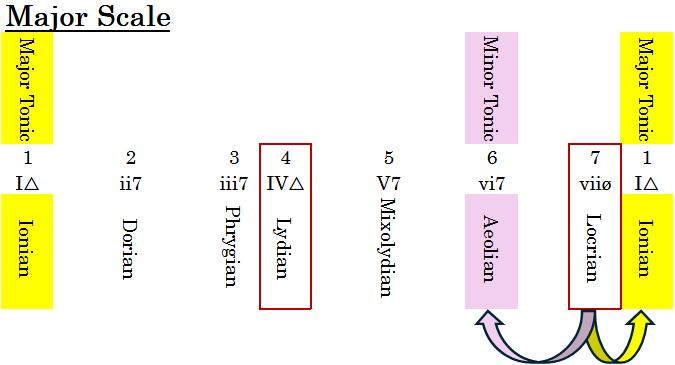
If we do use a Minor Tonic, then we are entering the realm of the Natural Minor Scale. The next chart shows that scale, which happens to have the same modes, but different degrees. The chords really don’t change because each chord is tied to a mode. Compare both charts for yourself and you’ll see different roman numerals, but the same chord type of each mode.
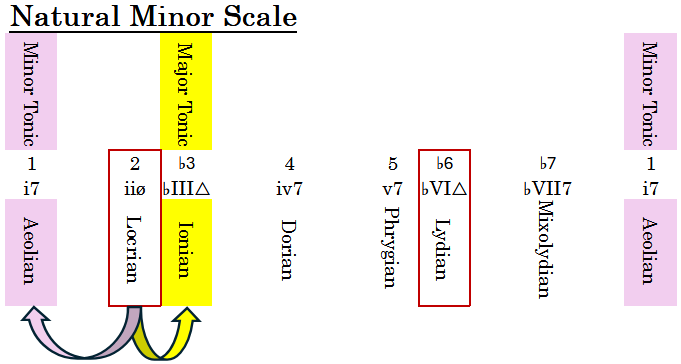
We can still use the 7th degree of the Major Scale to find either Tonic (major or minor), but here’s where having a little knowledge about modes comes in handy.
It isn’t the 7th degree that points to both Tonics. Its the Locrian mode that points to both Tonics.
By using Locrian as a way to take hold of the “guides to a Tonic” function, we can see that in the Natural Minor Scale, it is degree 2 that guides us. So a simple rule would be, “if you are in a minor scale, then degree two can access Locrian and help guide our ears”.
Fitting In Perfect Notes
So what about Lydian? To understand that we need to look at our two “perfect degrees”: the 4th and 5th. These two degrees are always referred to as the Perfect Fourth and Perfect Fifth for a few overlapping reasons.
The 5th is perfect because the frequency of that note fits “perfectly” with the 1st degree note’s frequency. Think of these sound waves like two nesting dolls that fit just right. That’s the short explanation.
If you move from the 5th degree DOWN TO the 1st degree, that distance is 3 and a half steps. The 4th degree is also perfect because you can move from the 4th degree UP TO the next first degree and that is also 3 and a half steps. In this way, a Perfect 4th is the inverse of a Perfect 5th. If the 5th degree is a nesting doll that fits INSIDE the 1st degree nesting doll, then the 4th degree is a doll that WRAP AROUND the 1st degree “perfectly”.

Mirrored Movements Matter
Now we can get to Lydian! In the Major Scale, we use the 4th degree as our note that creates a sense of “movement”. The 5th degree simply fits in with the Tonic note.
In the Natural Minor Scale we invert what our brains hear. Think about Locrian as a guide to either a major or minor Tonic. One movement of a half-step from Locrian gets us to a Major Tonic, while a whole step gets us to a Minor Tonic. In this way a half-step and whole step are inverses of each other. But there’s more!
In Major Scale the 5th degree fits with the Tonic and the 4th degree creates movement. But in Natural Minor the 4th degree fits with this Tonic. So where does the movement? Well, it stays with Lydian. In Major Scale, Lydian is what starts the sense of movement and it HAPPENS to start on the 4th degree of the scale. In Natural Minor, the 4th degree is our Perfect note that works with a Minor Tonic and degree ♭6 starts Lydian. Take a look at the previous Natural Minor Scale chart to see where Lydian physically fits in.
Now to use it! Grab an instrument or download a piano app to your phone. Take a moment to look up notes for your instrument and try out this simple exercise in A Natural Minor. The note A will be our 1st degree note or Tonic note.
Play and Am chord using these 5 notes: A-E-A-C-E. This is a guitar chord, but the spacing of the notes really helps you heard what’s going on. This chord is a “Tonic Function” because it is “at rest”.
Now we are going to ramp up the tension with a Pre-Dominant Chord. In either scale this is the note that begins the Lydian mode. So play A-E-A-C-F. The note F is the ♭6 of the scale and creates movement. Did you feel it?
Next up is the Dominant Function. That requires the notes from Lydian and Locrian. Play A-E-A-B-F. The note B is the Locrian note starting on degree 2 of the scale. Combining B and F creates that sense of “pointing to” and “movement” that really ramps up the tension.
Complete the movement of chords by returning to A-E-A-C-E. This drops all of the tension out and returns us to a Tonic Function.
Let Lydian and Locrian be Your Guides!
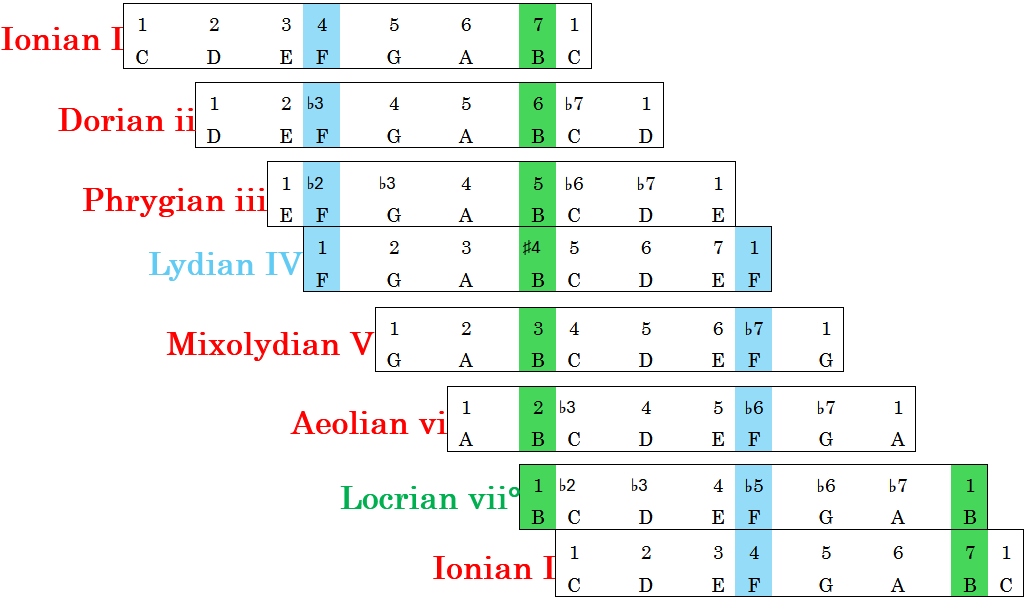
Above we have our seven modes with Lydian and Locrian notes highlighted in blue and green. Whether you start on Ionian to overlap with the Major Scale or start on Aeolian to overlap with the Natural Minor Scale, then you’ll always have Lydian and Locrian in there relative positions.
Again, in Major we have Lydian on degree 4 and Locrian on degree 7. While in Minor Locrian is on degree 2 and Lydian is on degree ♭6.
No matter what mode you are using, Lydian and Locrian can always be accessed to create functional movements. If you are practicing a mode like Dorian, then be aware that degree ♭3 starts Lydian and degree 6 starts Locrian. Playing modal music that is centered around something other than the Major and Minor Scales puts Lydian and Locrian in different locations. Above we can see that D Dorian uses the notes D, E, F, G, A, B, and C. The note F is the ♭3rd and starts Lydian while the note B is the 6th and starts Locrian. Even if we use D as a “Modal Tonic”, we could accidentally use the notes B and F to move our ears toward the note C for a Major context or the note A for a Minor context.
So how do we make our ears and brains understand that D is the Tonic note in D Dorian. The first step is to see that Dorian has a ♭3 and a 5th, so it is a Minor mode and we can treat it similarly to a Minor Scale. In Natural Minor, degrees 2 and ♭6 guide us back to degree 1. In Dorian we do not have a ♭6. We only have a 6th degree.
To “correct this for our ears” we can flatten that 6th degree for a moment. In this case, D Dorian has B as the 6th degree, so B♭ is the ♭6th of D. Luckily we have a 2nd degree to use in D Dorian, which is the note E. So by using E and B♭ we can make D sound like the Tonic.
Another way to look at this is through degrees. Natural Minor Scale uses degrees 1, 2, ♭3, 4, 5, ♭6, and ♭7. There are three flat degrees: ♭3, ♭6, and ♭7. The Dorian mode only has two flat degrees: ♭3 and ♭7. By taking Dorian’s 6th degree and temporarily altering it to a ♭6 we also temporarily access Natural Minor, which includes Locrian on the 2nd degree and Lydian on the ♭6th degree.
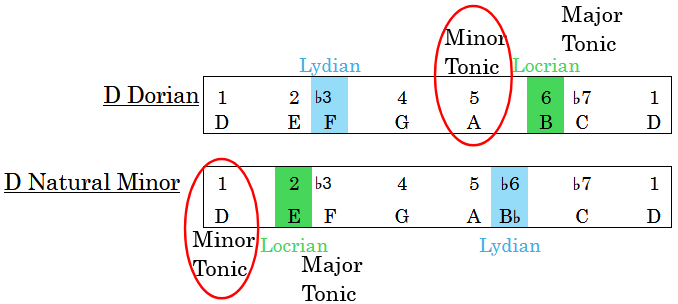
Above we can see how this all lines up. Playing strictly in D Dorian creates a cool jam session, but the locations of Lydian and Locrian make A feel like the Minor Tonic. By using the note B♭ we can access D Natural Minor for a moment and make D feel like it really was the Minor Tonic after all.
Try playing two chords back and forth: D minor and G major. The notes are D-F-A and G-B-D. Do this for a bit and then go to A minor with A-C-E. We were using the note B in our G major chord, which is the 6th degree of D. By using an A minor chord we use the note E, which is the 2nd degree of D. This makes the D minor chord feel like a Dorian chord because degrees 2 and 6 are being used.
When you get to the A minor chord we do not have a B or B♭ note. So, play a little melody that uses the notes E and B♭ in it. These are the 2nd and ♭6th degrees of D and will cause the D minor chord to feel like its actually in D Natural Minor.
Experiment with notes of scales and modes that start Lydian and Locrian, this will always make the notes neighboring Locrian feel like the Major Tonic ( a half-step up) and Minor Tonic (a whole step down). Also experiment with altering degrees. If you you are in a Major mode that is lacking a 4th or 7th, then alter what is needed and you’ll get the Major Scale and all of its functionality. The same goes for Minor modes. If you are lacking a 2nd or ♭6th degree, then make an alternation and you will get Minor Scale functionality.
In the end we are mapping two specific degree notes (Lydian and Locrian) to find a third note (Ionian or Aeolian, which overlaps with Major and Minor Scales).
By altering degrees we can REMAP where Lydian and Locrian are and therefore REDEFINE which single note is the Major and Minor Tonics. As always, feel free to leave a comment and ask any questions. I’m always happy to help. Until next time, keep on rock’n!
