
Voice Leading with Neapolitan Chords
A quick lesson in how to control notes with a particular harmony.


The other day I was messing around with Neapolitan chords and ended up creating a voice leading exercise. To understand how this works we need to know what a Neapolitan chord is and have some basic rules for voice leading.
The Neapolitan chord has a rich history and comes in multiple flavors. The one that we will focus on is the original Italian version. The chord its is notated as “N6”, but I want you to be able to use this in any context so I will avoid the deep-dive into this notation. Instead, I’ll refer to this as a “♭II/4” because the way you construct this chord is by taking a major triad that is built from the ♭2nd degree of the scale and playing it over the 4th degree of the scale. In C major or C minor, D♭ is the ♭2nd of either scale. So we start with a D♭ major chord and then place the 4th degree note, which is F, under that. One of the nice things about this is that it works in major and minor keys, but in minor keys there is only one note that does not belong to the scale, which is the ♭2nd itself. In major keys, the ♭2nd and ♭6th of the scale are used and both do not come from any major scale. In the examples for voice leading, I’ll focus on using the minor scale so that you can see and hear some similarities and contrasts.
Voice leading is where we imagine having a group of singers. Each person can only sing one note at a time and they would all appreciate having as little to change between notes as possible. So think of one person singing the note C. The rule that we will focus on is making sure that the next note they sing is a major-third away or less from the previous note. A major-third is the distance of two whole steps. So C can move down to A♭, up to E, or anywhere between A♭ and E. It can even remain in the same place and stay the note C.
Another rule we will use is only to help our singers have something to do. In each bar we want any singer that started singing to have something to do all the way through. We’re only going to use three chords, so each singer will only have three notes each. We’re also going to use notes that are already present. By rearranging the notes we can avoid having to think about adding notes to solve each example.
A final step to constructing these examples is through tension. The first chord will be a high-tense chord, the second will be the Neapolitan chord with some tension, and then we will end on a minor tonic with no tension. Let’s dive in to the examples.
Example 1: Diatonic Dominants
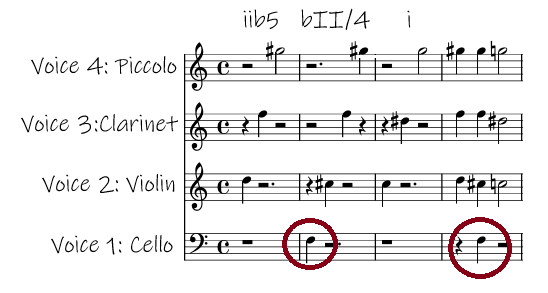
Above we have four voices that will be played by instruments so that when you play the audio example you will have an easier time hearing everything. Voice 1 will be panned to the left and Voice 5 will be used later and panned right. The other voices will be arranged left to right so that each voice has space. Each example will have a ♭II/4 chord followed by a i chord, so only the first chord will change between examples. You’ll also see roman numerals for chords that have negative numbers next to them. The negative number means it is an inversion, so a Cm chord as i(-1) means to put the first note AFTER the root note in the bass. Cm is played as C-E♭-G, but Cm(-1) is played as E♭-C-G. Rearranging the notes will be the key to creating a nice voice leading flow.
You will also see that each example consists of four bars. The first three bars will let you hear the voices individually in arpeggios, while the last bar will use the same notes as stacked chords.
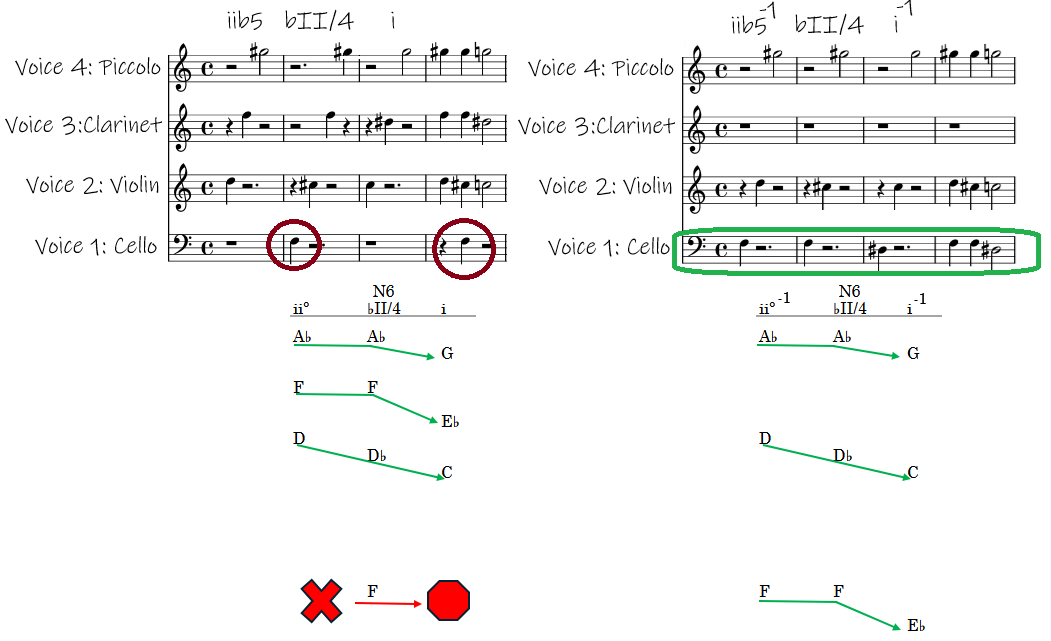
In the above example, the note F is circled. This is our problem child because the Voice 1 singing this note only has one thing to do. That’s pretty boring.
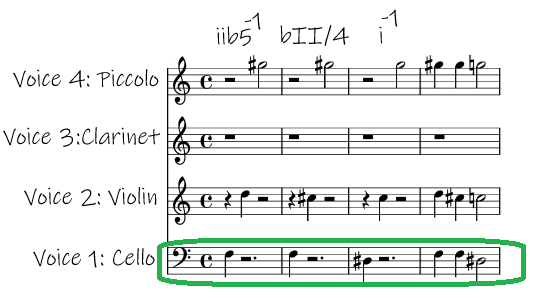
To fix that we can give Voice 3’s job to Voice 1. Sure, the third voice has nothing to do, but at least they didn’t get started. Another way of thinking about this in terms of an 88-key piano. We don’t need to think of up to eighty-eight voices, so let’s focus on only what is needed for the sake of the music itself. Now Voices 1, 3, and 4 all have something to do and each subsequent note is within a major-third (two whole steps) of the previous note. We also solved this without adding any additional notes. We only used notes that were already present.
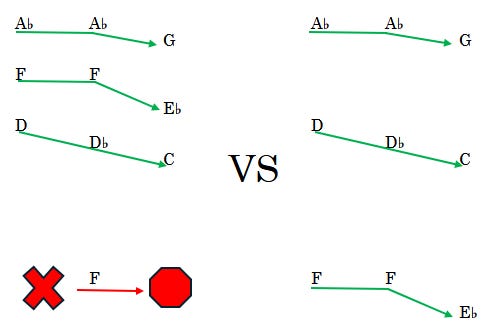
If you have a hard time with sheet music, then write out the notes of a chord with the lowest pitch at the bottom. Above we have the exact same example with just lettered notes. I put an X and Stop sign to show that one voice had nothing to do, sang the note F, and then stopped. I also connected the notes so that we can visually see the movement that each voice takes. I’ll put all of this and audio examples at the end of the lesson.
Example 2: Secondary Dominants
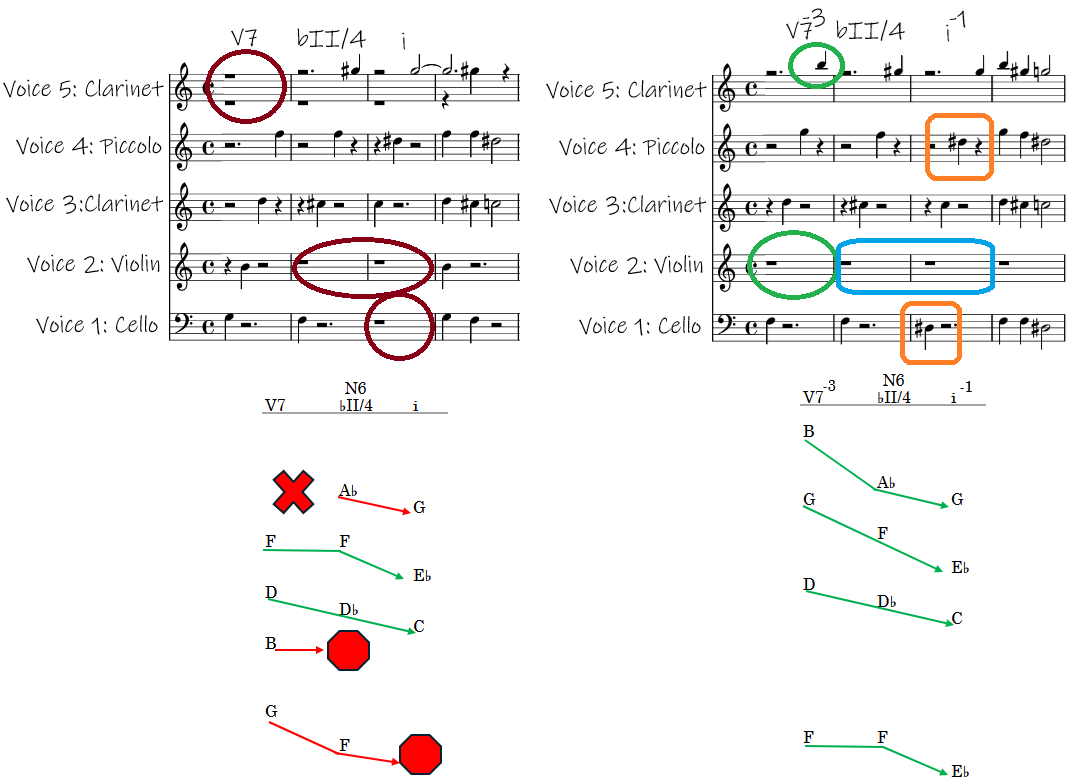
The first chord of the next example is the Secondary Dominant of Cm, which is G7. Minor scales don’t have a direct dominant chord the way a major scale does, so we add in G7 as a “secondary” option that replaces the chord Gm7, which is part of the C Minor Scale.
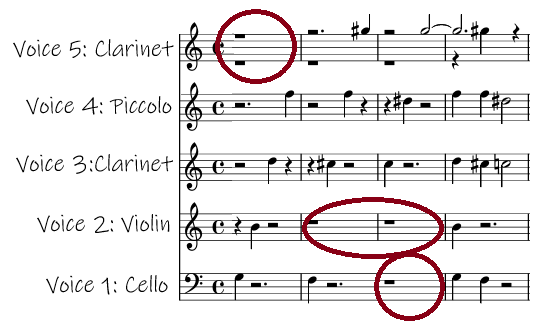
Above we have three problems. Voices 1 and 2 end early and Voice 5 starts late.
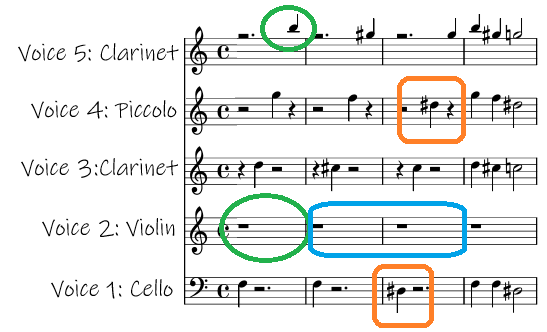
To fix that we can take the only note from Voice 2 and give it to Voice 5, shown in green. This allows Voice 2 to take a break and automatically solves the silence this voice had shown in blue. Voice 1 gets a note added in orange, but this is a note that we already have in the chord, which is found again in Voice 4. So everyone that is singing will have something to do, those that are not singing can take a break, we stick with our rule that keeps us from moving notes beyond a major-third, AND we only used the notes we already had.

Example 3: Dominant Tension from Non-Alternating Thirds
So what the heck is a non-alternating third? This is when you take a major-third (two whole steps) or a minor-third (a step and a half) and keep stacking the same type of third to make a chord. If you stack minor-thirds you will get a diminished chord. Stacking major-third give you an augmented chord, which is what we will use in the last example.
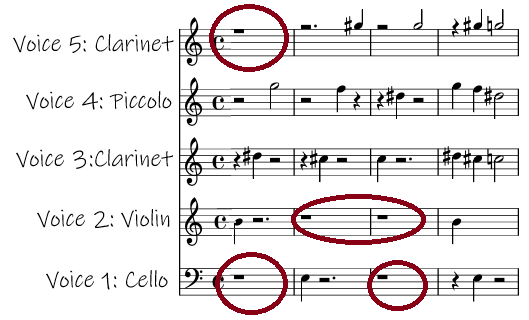
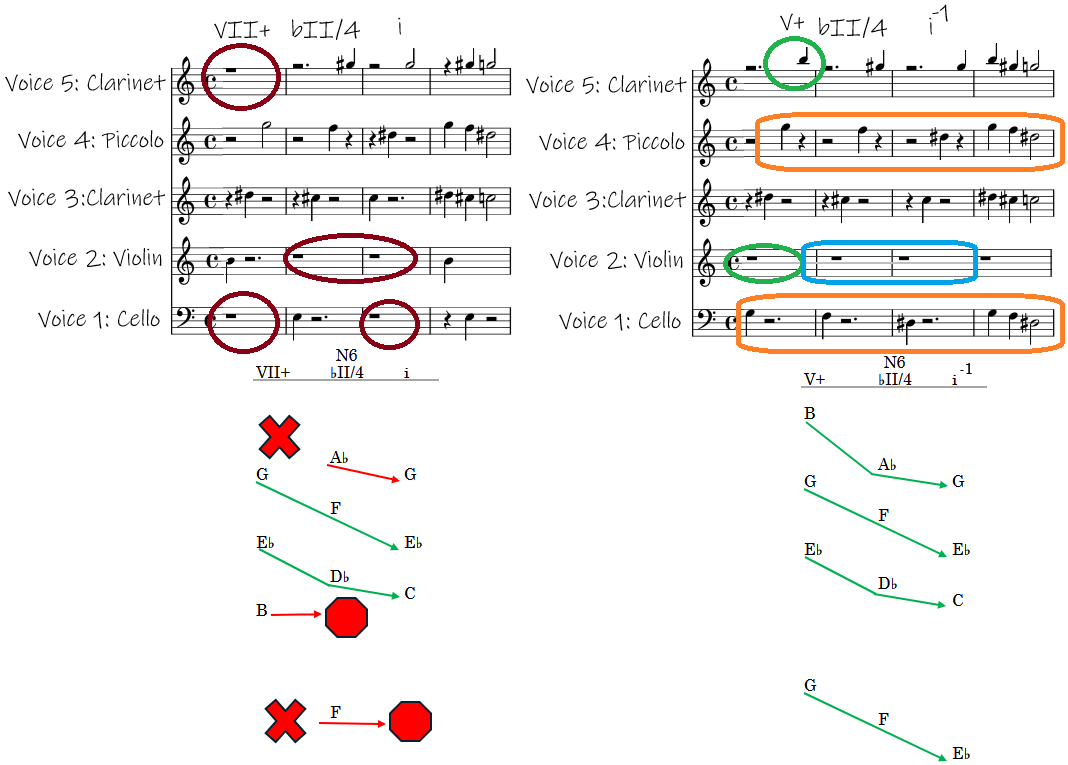
This time we start with an augmented chord, but Voices 1 and 5 have nothing to do. Then Voices 1 and 2 end early.
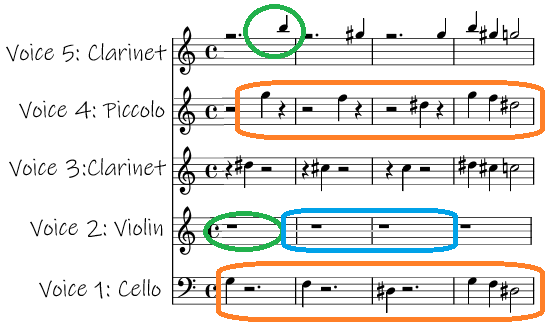
To solve this we can still take the note from Voice 2 and give it to Voice 5. Just like the second example, this frees up Voice 2 to take a break. We then replicate Voice 4’s note for Voice 1, which is similar to what we did in the first example. All of our rules are maintained and now we have a smooth transition.
Audio Examples
Below are the same three examples with the lettered note versions and audio clips so you can hear how voice leading has improved the flow of the music.
EXAMPLE 1
EXAMPLE 2
EXAMPLE 3
Keep working on your voice leading with other chords and melodies. Also, be sure to experiment with the Neapolitan chord. This chord functions as a pre-dominant and can be used in both major and minor scales. I’m sure you’ll continue to discover that concepts like these can really open your mind to the possibilities in music.
