
Metal is just Heavy Jazz
Getting a new perspective on the musical realm of metal.

All long time ago in high school far, far away…
I was born in 1981 and grew up listening to whatever was on the car radio. Phil Collins made a huge impression on me simply because he had one or more hits out there for the later half of the 80s. My mom was in charge of the radio station, so it was hard to not hear him, which caused his style stick with me. Genres like New Wave, Pop, and what is now known as Yacht-Rock were always around.
As I grew up, sources of music like MTV introduced me to Green Day, Collective Soul, Nirvana, Pearl Jam, Sound Garden, and more. But it wasn’t until one fateful day in high school that I was talking about music with a friend. He mentioned a band I never heard of and I will never forget his look of shock mixed with a a dash of disgust. That made me think, what’s so great about this band? Phil Collins is awesome! What could these other guys do that was so amazing? So he brought me a tape of their newest album. Yes, this is before the age of CDs. As I took he it he asked if I had headphones. Of course I did. But why would he ask? He then said, “…don’t let your parents hear this.”
So I got home, put my things away, and loaded my walk-man. Yes… a walk-man. I pressed play while reading the name of the first song. My eyes widened at the title and suddenly the first four notes slammed through my ears and into my brain. Just fifteen seconds in my neurons were on fire. Everything in me was running at full power. I have never been the same since and all for the better. If you want to experience this for yourself, then check out the video below.
Metallica’s sixth album titled “Load” was where my love of metal began. I didn’t have a lot of money as a teenager, so collecting the remaining albums took a little time. I then started collecting Metallica’s tablature books as I began to learn how to play the guitar. I can remember showing up to class early just so I could have a little extra time to study Metallica’s music.
Before I graduated high school, I found myself in a band playing rhythm guitar and doing backup vocals. Every once in a while the singer needed a break, but I wanted to keep going. So I jumped on the microphone and we kept at it. A normal Saturday practice session for me was to tune up, get some Coca-Cola and Rice Crispy Treats, and go for seven hours with only minutes between songs. While everyone else took breaks, I would keep going even if that was just working on technique. We ended up having to keep ice packs in the garage we jammed at for my arms. Without them, my arms would literally curl in toward my chest. My band mates would layer them on my inner forearms and would ask if I was too cold. Well, I could be cold or hurt in the morning. I took the cold.
Because I had people that supported me, I would work extra hard at home to make sure that I brought my A-game to every practice. This paid off one day when we played Master of Puppets, but I was the only one that knew all of the parts. To get everyone through it, I had to conduct while singing and playing. Our bassist knew what to play, but forget when a specific version of a pre-chorus came in. I told him I would walk up to him and jam right with him so he knew THAT was the time to shift into those riffs. I used a similar approach to help guide everyone. At the end of the eight and a half minute endurance song, it was up to me to do “the laugh”. I got two microphones set up since we had one for when I did back-up vocals, and ended up floating my voice while moving them to create the ambiance at the end of the song. In the end it sounded amazing. And yes, there’s going to be a lot of Metallica in today’s article. I may play a lot of Jazz, but they’ll always be my favorite band.
The Gritty Notes
I could go on and on about metal, but today I want to share with you some of the things that make metal so much fun to play. So here’s how it works with a few technical terms tossed around.
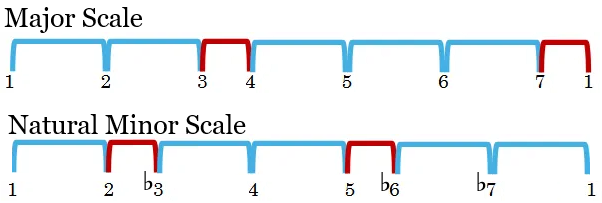
Most Rock music uses the Natural Minor Scale. Its similar to the Major scale, but three degrees are flattened. Below are both scales. Notice that in Minor, degrees three, six, and seven are flattened degrees.
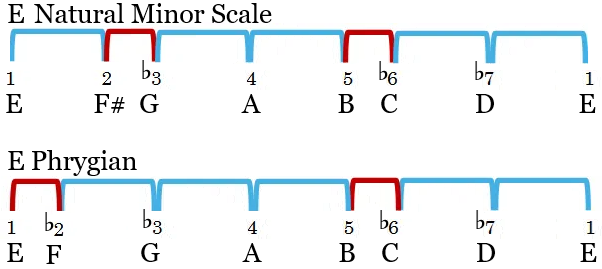
A lot of metal is played in E Minor because the lowest tone on a standard tuned guitar is E, so that’s what I’ll use when we talk about lettered notes. Below is E Natural Minor and the mode E Phrygian. The reason why this mode is so important is because of the degree ♭2. If you play E, F, E, F, E, F or 1, ♭2, 1, ♭2, 1, ♭2 you would get the Jaws theme music. The ♭2 is tense and that extra optional note is what metal needs for that extra horsepower.
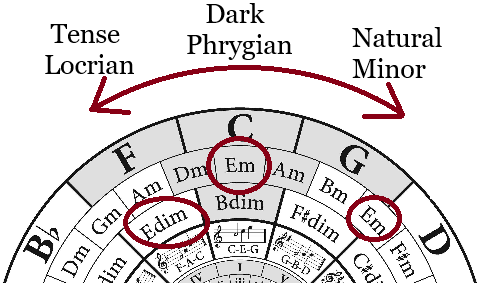
Now we could look at this like being in E Minor, which happens so be part of the key of G Major, and E Phrygian happens to be part of the key of C Major. When you look at the Circle of Fifths you can see that these keys are neighbors, so going from E Minor to E Phrygian is just a quick modulation between keys.
But that’s not how it works in metal.
Both E Minor and E Phrygian are true at all times. Songs like “For Whom the Bell Tolls” uses a super tight movement of 2 to ♭2 to 1, or F# to F to E, to pull our ears down into that low E tone.
But metal is more than that. In the same song the 2-♭2-1 is preceded by a ♭5. When the degree ♭3 is used, the only way to get a ♭5 is from the Locrian mode. E Locrian is conveniently found in the next key of F Major.
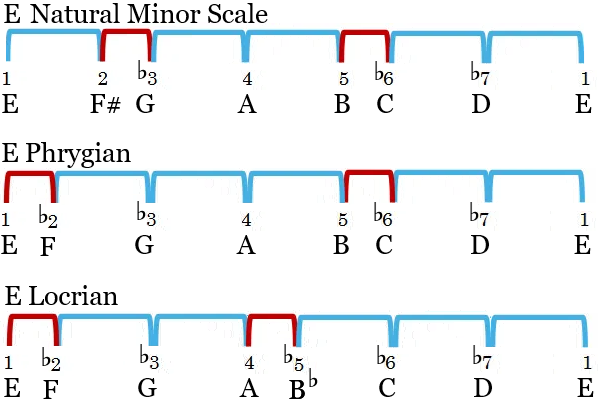
Above we have all three of our scales mentioned so far. Below is a portion of the circle of fifths with each scale pointed out under the keys G, C, and F from right to left. When the lyrics “Time march-es on” is heard, listen for the ♭5, 2, ♭2, 1. That tense pull down to the Tonic note of E is a great way to begin hearing how specific degrees creates a “metal” sound.

The Jazz Aspect
By this point you may be wondering how metal and jazz could ever work together? To see that we need to add one more degree: the Leading Tone. In any scale, the Leading Tone is degree 7 and is one note below degree 1. This note literally leads our ears up a notch from 7 to 1.
In a lot music, including Jazz, a chord called a Secondary Dominant is used. To make sense of this we turn to a Major Scale. The fifth chord in any Major Scale creates a Dominant chord that drives our ears to the first degree chord. Think of it as a 5 to 1 relationship. In E Major the dominant “5 chord” is B7 with the notes B-D#-F#-A. In E Minor we do not have this chord unless we add in the note D# to our scale. This note is the Leading Tone of E, also known as the seventh degree.
Below is our E Natural Minor Scale PLUS. This scale has degrees 1, 2, ♭3, 4, 5, ♭6, and ♭7 like a standard Minor Scale, but we get to include ♭2, ♭5, and 7. When we use a scale like this, try to not focus on things like every chord that is possible or melodies that use ♭3 to 2 to ♭2 to 1. That’s just too much. Instead, think of degrees 1, 2, ♭3, 4, 5 and ♭7 as your primary rock and roll framework notes. These notes work all the time and can get boring. To spicy up your music with a little metal, start using degrees ♭2 and ♭6 as your primary notes for ramping up the tension. Degree ♭5 is reserved for adding that extra tense grit just like when it was used in “For Whom the Bell Tolls”. Treat ♭2, ♭5, and ♭6 as spices of a tasty metal meal. Add them in when you feel it is tasteful to do so. Some dishes require a few dashes of ♭2. Others need several jars of ♭2.

Now you can add in degree 6, but that will cause the scale to sound like it is using tonality from the Dorian mode. That’s like adding in some smooth Carlos Santana, so it might not be the most “metal” way to go. But again, season your songs to your taste.
Another thing that the 6th degree can imply is the Minor Scale itself. In the context of the Major Scale, the 6th degree starts the Relative Minor. In other words, C Major’s 6th degree starts A Natural Minor. When we play most minor scales and modes, we have a ♭6, which is like saying we are in a minor scale so we don’t need the 6th to include a relative minor. Having two minor scales embedded into each other should imply some type of diminished sound, which is what happens when you stack two minor thirds. Again, another way to think about that is to imagine a minor third from B to D and another minor third from D to F. Stacking B-D-F makes a diminished chord. Now to beat this dead horse just a little more. In the Dorian mode we have a minor mode with a 6th degree. If we play Dm6 we use the notes D-F-B. Those are the same notes in B Diminished! So a minor scale or mode that includes a 6th degree implies that a diminished sound can be easily extracted using degrees 1, ♭3, and 6.
The third degree is the note that makes major modes and scales. Metal is all about minor so a ♭3 is a focal point to get that sound. With that said, there are scales that use degrees ♭3 and ♭4. The degree ♭4 overlaps with 3, so you can access every note possible from a minor scale. A common trick with a ♭4 in minor is to use it as a “passing tone”. This is used a lot in Blues, Jazz, and Bebop. Don’t be afraid to use it. Just know that it will be another “spice” to add to your musical dish… or to avoid completely.
Hearing the Tension and Color
But what about Jazz songs that touch into the realm of Metal? Let’s start with “Salt Peanuts”. For my fellow metal-heads out there, please don’t expect to hear distorted guitars or double-kick bass drums. The qualities you should look for in this song are in-your-face tension, fast hitting solos, and a creative use of chromaticism. That last one is very important. Since metal can use a variety of overlapping scales, chromaticism is where Metal and Jazz coexist in their use of musical language. Also, don’t think about this in terms of arena sized production. Imagine your favorite metal band in a small club. Now listen to “Salt Peanuts” and imagine being at the front row but with Jazz Cats that are not here to sing you a lullaby. They’re gonna blow you out of your seat.
Another favorite of mine is “Moanin’”. This is not a fast song, but it does move you. Think about songs like “Sad But True”. That one is low and chugs along the whole way. Again, keep the idea of stadium sized performances at bay. This is a big-band production that hits in the right spots and then eases off only so that all of those nasty-notes can be heard. This song is full of whines, grunts, and of course moans. Listen for the Moan’n context for the grit in this song rather than a bunch of loud amps.
The Jazz-Metal Challenge
Without getting into palm muting, gallops, chugs, and distortion, we can still take a lesson from metal and use parts of it in Jazz. Take a song your know well that is in a minor key and write out the notes in it. Then add in degrees ♭2, ♭5, and 7. The song you pick doesn’t have to be a Jazz song. It can be anything you like. If you need a song, then learn Autumn Leaves. It’s a great jazz standard that is my current Turing Test / Sandbox for minor scale ideas.
The challenge is to take this song and mix in some ♭2, ♭5, and 7 as you see fit. Alter a melodic line that uses degree 2 and swap in a ♭2. Better yet, if the melody is 4-2-1 then play it as 4-2-♭2-1. Experiment with the way these notes add tension. Especially the ♭5. A melodic line of 5-5-4-2-1 with any cool rhythm can also be played as 5-♭5-4-♭2-1 to really crunch that movement down toward the first degree note. And remember, degree 7 pulls our ear to degree 1. Try any rhythm you like with a 1-1-2-♭7-2-♭7-1 and then play it as 1-1-2-♭7-♭2-7-1. That causes the twos and sevens to converge on degree 1 from both sides and gives a nice tense push & pull feel.
If you allow yourself to embrace the tension in metal, then you’ll begin to embrace the tension in other musical styles. As you learn more about music with scales like Harmonic Major, Harmonic Minor, and Melodic Minor you’ll also be able to use the “tension in metal” to make sense of things like a ♭6 in a Major Scale more quickly because its just another form of tension.
One More Thing
Before I wrap this up, try listening to the song linked below. Especially if you want to learn from metal, but don’t know where to begin. There are no lyrics in this song. There is only the journey! Enjoy some Orion.
