
Linking Music with Color
Equating musical scales and key changes to combinations of color on a painter's pallet.

Today I want to talk about key changes from a different point of view. I also want to cover this topic in a way that works for you no matter what musical skills you have.
If you’ve heard about key changes or comparisons between keys, then you’ve likely heard terms like “brighter” and “darker”. I don’t care too much for such direct wording because there is always a way to create brightness and darkness no matter what key, scale, mode, chord or other musical device you might be using. Instead, think of these contrast as pictures. You may start in one key to describe the sound of a sunny day. Changing keys doesn’t make the day brighter or darker. What happens is that you begin to add in more to the picture. You can add in the feeling of a glass of tea in the sunlight or the feeling of an oak tree that cools the scene with its shade. Neither are bright nor dark. They are musical ideas that convey contrast, tone, and most importantly: feelings.
Since this is for every level of musical aptitude, let me list some basics. This way even those of you who are new to music can have a list of criteria to slowly enjoy learning that will lead you to today’s concepts.
Also, I have a video at the end so that you can visually watch this concept in use and avoid needing any musical skills.
A Few Starting Points
While you don’t need to have a strong background in music, each of these steps will definitely help you to see the bigger picture.
3 Beginner Steps
Having an instrument. Even a free piano app on your phone is a great way to get you physically connected to sounds, tones, and musical structures.
Learn the notes and triads of a major scale. There’s only 7 notes in a major scale and 7 basic triads. Learn a few at a time and you’ll build up a pallet of colors to paint musical pictures.
Learn the notes and triads of the related minor scale. This will be the same notes and chords of the major scale you learns, but the order is slightly different. You’ll notice a big change in tone and begin to paint new sonic images with the same musical notes/colors.
2 Intermediate Steps
Learn about the Circle of Fifths. Treat this as a road map that organizes notes in groups. Each group is a pallet of colors.
Be able to find the parallel major of a minor scale AND the parallel minor of a major scale. You’ll notice patterns in which notes change and which do not. Treat these changes as “shading”. We are not completely changing notes between two keys. We are changing the “tone” of a few colors within a pallet of notes.
Yes, this is quite a bit to cover. I get that. But if I can’t expect everyone to appreciate today’s main concept if I don’t (AT LEAST) cover the basics. If you’re feeling overwhelmed by what I’ve already outlined, then write these things down. Work at them a little each day. It will take time, but as long as YOU ARE PATIENT WITH YOURSELF, then you will build confidence. Now let’s get to treating musical notes as colors.

A Circle of Pallets
Below is the Circle of Fifths, but with no notes. Think of this as a road map that connects similar musical ideas. If you are unfamiliar with the Circle of Fifths, then think of each point as a collection of 7 notes. Each neighboring set of notes is exactly the same as it’s neighbors as side from one note that is different. What makes this useful is that every collection of notes can be numbered 1 through 7 and they all function the same way. The difference comes when we start comparing collections of notes/colors.
Instead of note-letters we have the numbered degrees with the colors of the rainbow, which are in order for the “Relative Major”. If you were to use the C Major Scale, then C would be red, D would be orange, and so on. This works with any major scale. So in A Major the note A would be red, B is orange, C# is yellow, and so on.
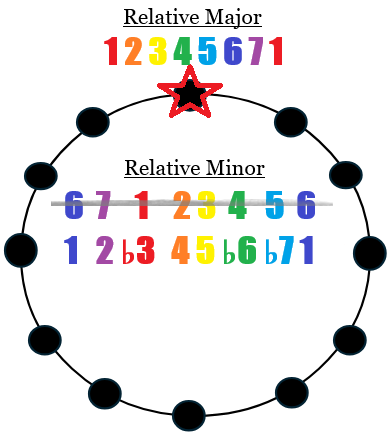
The “Relative Minor” uses the same notes, so it is the same colors. The difference is that the relative minor starts on the relative major’s 6th degree note. In terms of color, indigo is the 6th color in the major scale’s rainbow, but it is the 1st color in the minor scale’s rainbow. The order of the colors didn’t change, because the order of the notes didn’t change. You may be looking at the three flat degrees in the relative minor scale. Think of each note/color as taking on a new role. This allows us to paint musical images with the same colors, but with different context.
If you start in the major scale, there are ways to navigate to the relative minor and back. The same goes for starting in the minor scale and navigating to the relative major. You can go to my archives section and search for terms like “functional harmony” to find plenty of resources that show how this type of navigation can work.
Now we want to be able to access the parallel minor.
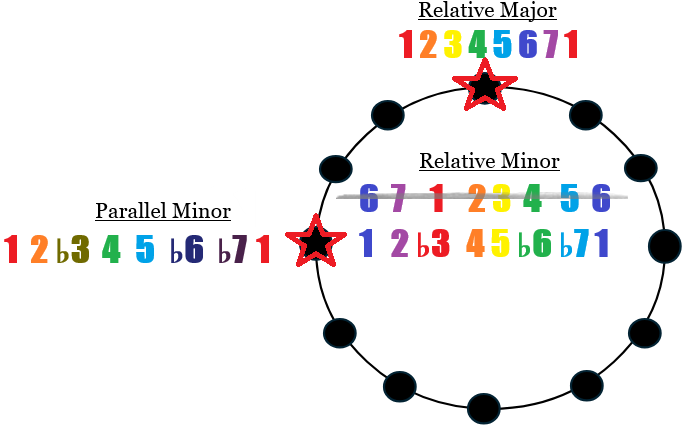
If we take the major scale and flatten the 3rd, 6th, and 7th degrees / colors, then we get the parallel minor. This is a 90 degree turn counter-clockwise on the circle. When we navigate between all three pallets, we use the major scale as a center. Below the relative major is the main pallet of colors. We can access the relative minor to redefine the colors themselves, or we can flatten three colors to access the parallel minor.
An analogy to this could be that the relative major is our sunny day. We can explore the shadows of the trees in relative minor without changing the color pallet. We can also opt to make it rain a little and add in the ♭3rd, ♭6th, and/or ♭7th of the parallel minor. The point is that the main pallet of the relative major never left. We simply accessed other scales/pallets to enhance our painting.

We can also use the relative minor as the center pallet. To get to the relative major of a minor scale, you raise the ♭3rd, ♭6th and ♭7th and move to a key that is 90 degrees clockwise on the circle.
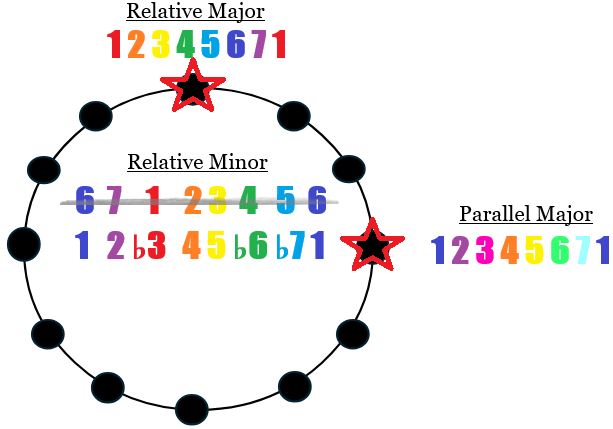
Using the relative minor as the main pallet, we can alternate between either major scale in the same way. Relative minor’s colors can be redefined as the relative major and/or three of the colors in a minor scale can be “sharpened” to create a new “parallel” major scale.

Putting It All Together
Below are two ways of visualizing all of this. Either way you want to use a major or minor scale as the MAIN PALLET. In terms of key, C Major and A Minor use the same notes, so one of those will be the main pallet. Let’s use C Major as an example. A Minor would be the relative minor and C Minor would be the parallel minor.
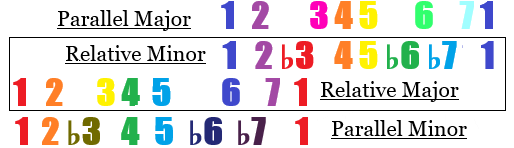
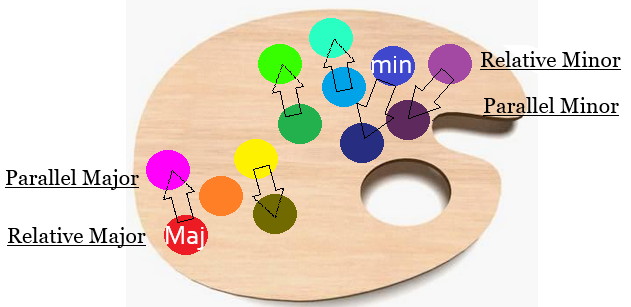
The literal pallet shown above uses the same 7 notes/colors through the center strip. Major can become minor by starting on the 6th degree, which uses the same notes/colors. Flattening the 3rd, 6th, and 7th notes/colors gives us access to the parallel minor.
In order to go from a relative major to a parallel major, we first access the relative minor by redefining the 6th note as the starting point. Then we can sharpen the new 3rd, 6th, and 7th notes/colors to access the the parallel major.
There are No Limits
Keep in mind that we’ve only “STARTED” at one position on the circle of fifths out of a total of 12. Here’s a way to visualize this.

Each of the 12 positions of the Circle of Fifths contains the notes of a major and a minor key. Using C major / A minor as a “central pallet” (which is is the left circle of colors out of the four above) we get the 7 colors of the rainbow on a tan strip of a painter’s pallet. The bottom three keys can have sharps OR flats, so there is some overlap. The other three keys shown above are just the first one rotated clockwise. AND THAT IS THE POINT OF THIS LESSON.
Whatever key you choose as your main key will contain the standard colors of YOUR main pallet.
All other keys, scales, etc. are adjustments to YOUR sonic canvas.
The best part about painting with music is that it doesn’t last. As soon as the notes end, they begin to fade away. Don’t think of this as if the painting you just made is dying off. Think of it as playing part of a song to create a lake with trees. The music changes and takes us from the lake and down a stream. Other colors outside of the main pallet are used to create flower, birds, shadows, and emotions. We then arrive at another lake in the chain. It uses the same sounds as the first one, but it’s not the same. The first lake’s paint is gone. Its been covered by the paint of the stream, which in turn was washed out to create the second lake. When we end the song we walk away from the painting. The painting didn’t die off. It’s colors just can’t be heard… unless you image it in your mind’s ear.
The see this in action you can watch the video below. This is Mozart’s Piano Sonata No. 16 in C Major. If that doesn’t mean much to you, then know that C Major only uses the white keys on a piano. This song uses C as the 1st degree note and the white keys of the piano as main pallet. Watch for the use of the black keys in either hand. Those notes DO NOT belong to C Major yet add color to this sonic painting.
You don’t have to know a bunch of technical jargon to appreciate the use of an expanded rainbow. Enjoy!
As always, feel free to like, comment, and subscribe for free. Until next time.
