
Chopped! Musician Edition
Come jump into my musical kitchen and mix up some tasty tunes.

Prerequisites for Entry Into the Kitchen
This lesson is for intermediate to advanced players. Beginners are welcomed to learn, but you'll want to be familiar with the following concepts. Even understanding a small portion of these will help you out in this lesson. You can can use the search icon (the magnifying glass) at the top right of the archives section to find plenty of lessons that involve these topics.
The Circle of Fifths
Major and Minor Scales
Relative and Parallel Keys
Parallel Modes
Alternate Parent Scales: Harmonic Major, Harmonic Minor, and Melodic Minor
Major and Minor Chord Forms
Diminished and Augmented Chord Forms
Suspensions and Add Chords
Voice Leading
Now grab a piece of paper, a pencil, and download a free randomizer for your phone. Really anything will work as long as you can pick 1 out of 12. A randomizer app that lets you set a range from 1 to another number is preferred over dice or flipping coins because it will help you save time. If you don’t want to download yet another app, then you can CLICK HERE to use Google’s web-based random number generator. Just change the range and click away.
The last thing to do is write out all 12 notes in an octave and the chord forms that you know. I like to use “Ab, A, Bb, B, C, Db, D, Eb, E, F, Gb, G” as my notes, but sharp notes are just as valid. Number your notes 1 through 12 and write out chord forms. If you're new to music, then triads like major, minor, and diminished are just fine. You can expand this list with tetra-chords like maj7, m7, 7, and m7b5. You can also use sus2, sus4, add9, add11, and add13 forms as these can fit multiple modes. Augmented chords do not belong to the major or minor scale, but they do line up with other parent scales.
To use this lesson as a learning tool, be sure to put some chords you don't use a lot in your list. This way you get the chance to experiment with them. Below is an example of what to write down.

How to Play the Game

In the show “Chopped!”, contestants get baskets containing four mystery ingredients which they have to use to make an appetizer, entrée, or desert. They can use anything else they want to make these ingredients the highlight of their dish.
What we will do is use our randomizer app to pick random root notes and chord forms. Beginners may want to stick with just two random chords, but those looking to expand their musical headspace should use three or four random chords at a time. You can make this easier by using chord forms that you are familiar with, but if you want to learn something then I suggest incorporating chord forms that you don’t use all the time.
Once you have a set of chords, look at the notes and figure out which keys these could be used in. Now its up to you to make them work. Keep in mind that you can use anything to bring these chords together. The goal is not to see how many random chords you can use. What you’ll want to focus on is HOW YOU USE THEM.
An Evolving Example
When I tried this out with two chords I got Ebmaj7 and Gm7b5. These two seemingly mismatched chords are actually very close together. My first idea was to use Ebmaj7 as the I chord (first chord of a key), which makes it the first chord in Eb Major. Within that key we have Gm7, which uses the Phrygian mode in Eb Major. If I take the 5th degree of Phrygian and flatten it, then I get the Locrian, which gives me access to a Gm7b5 chord. Since it’s the 5th of G that I flattened, I need to focus on that note and its flat version. The 5th of G is D, so I can play Eb Major with the note D and then modulate to Ab Major by using Db. All of the other notes are the same in BOTH KEYS.
Another way to use Ebmaj7 is as the IV chord in Bb Major. In that key I have another Gm7, but this time Gm7 uses the Aeolian mode. This means that to access G Locrian’s Gm7b5 chord, I will need to flatten A and D to Ab and Db. But that’s where the fun begins. Now remember, I don’t have to start or end on either chord. I just need to use them in some way. And yes, arpeggios are acceptable. As long as the notes that make up the chord are used in a way where you can hear the chord existing, then you’ve made a good musical dish.
I then decided to add in a third chord and got Abm7. In the key of Eb Major, Ab starts the Lydian mode and gives us an Abmaj7 as the IV chord in the key. Using a iv (minor “four-chord”) is not uncommon. A iv to I is a “Minor Plagal Cadence” and is used a lot in love songs. Try a IV, iv, I in any key with the words “I”, “love”, and “you”. You’ll hear it right away.
When a IV chord becomes a iv chord, the Lydian mode tends to shift down to the Dorian mode. In other words, three notes will be flattened. This takes us from the key of Eb Major to Gb Major. WHEW! See how quickly a third chord can complicate things?
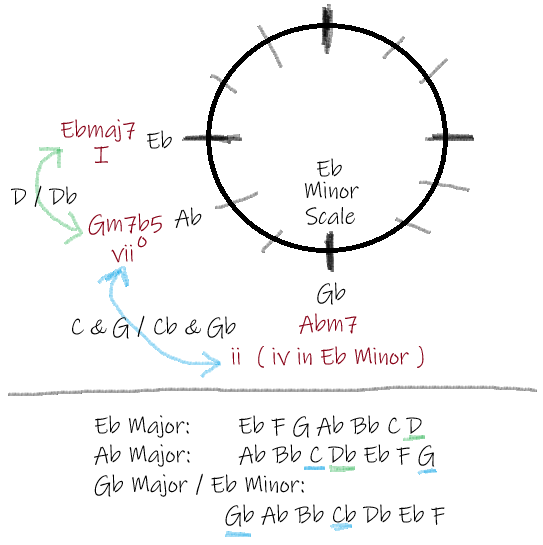
The chart above is a version of the Circle of Fifths that focuses on these ideas, along with the notes for each key we will use. So let’s go over them one more time.
Ebmaj7, Gm7b5, and Abm7 are our chords to use in some way. These are written in red.
The only difference between the keys of Eb Major and Ab Major are the notes D and Db. This is highlighted with the green markings.
The only differences between the keys of Ab Major and Gb Major are the notes C & G flattening to Cb and Gb. This is highlighted with the blue markings.
The notes in Gb Major are the same as Eb Minor. This lets us connect Eb Major and Eb Major as parallel scales.

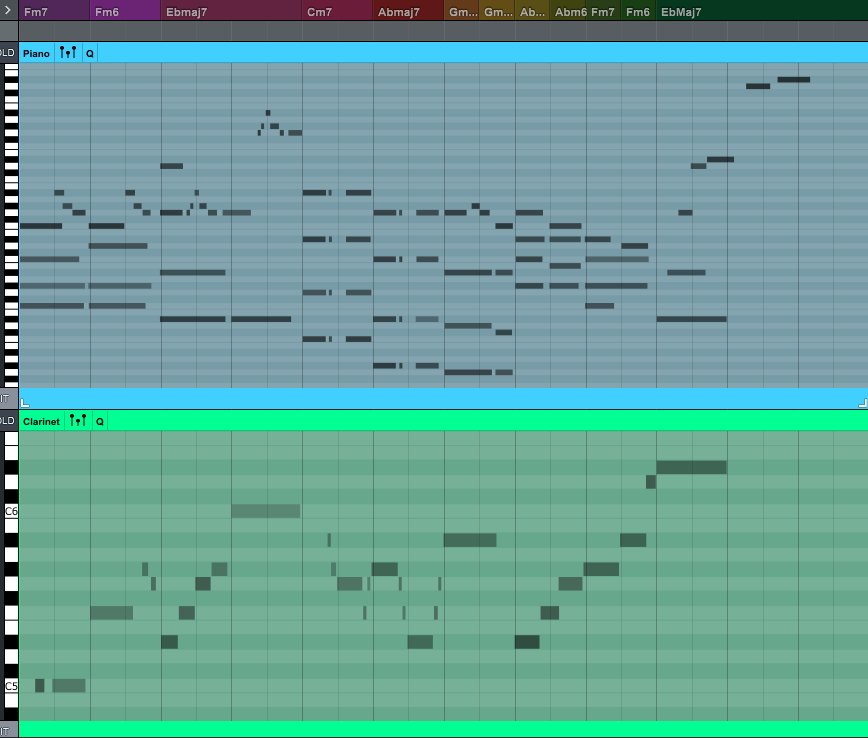
So here’s what I came up with. Please forgive the extreme use of rests along with the use of sharp notes even though we are using flat keys. I’m experimenting with a “MIDI to sheet music converter” that has worked well for me so far. If you want to try it out, then go to Melobytes.com. If you are wondering why the rests are all over the place, its because I did this by feel. I tried to quantize this in my DAW (digital audio workstation) but the feeling I created fell apart. Thankfully, you can still get a sense of the movement through the notation itself. You can also listen to this at the same time. Don’t worry. I went slow at 60 BPM (beats per minute). If you are listening via a phone, then hold it sideways. Depending on the phone, you may get a little left and right separation that way.
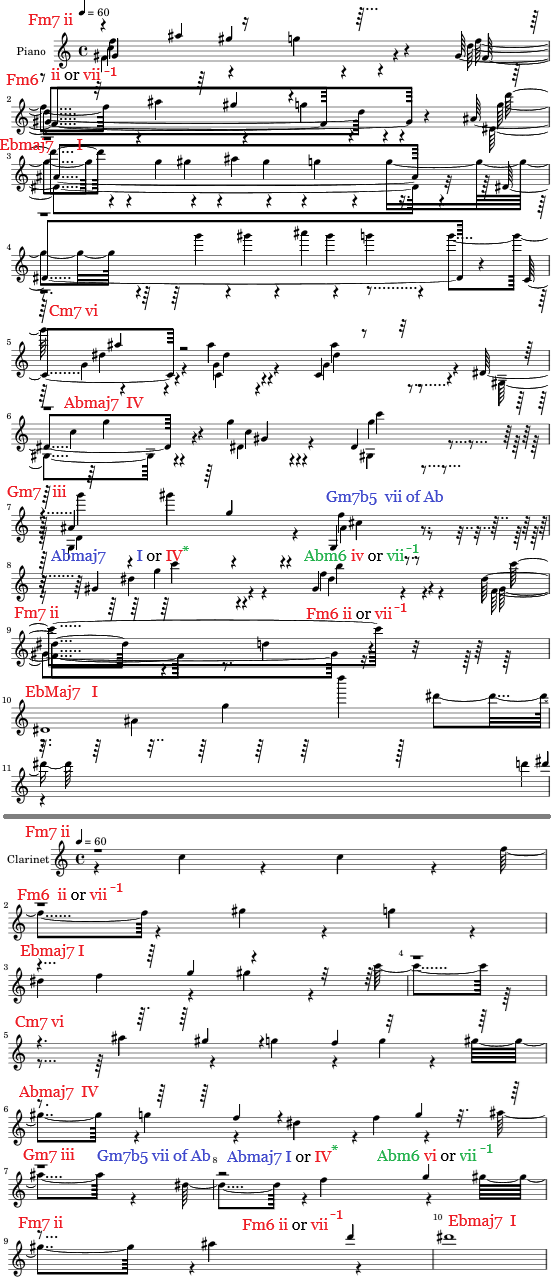
Now let me boil this all down into a few concepts. (Pun intended.) First of all, the chords I had to use are:
Ebmaj7 from the key of Eb Major, which is shown with red notation.
Gm7b5 from the key of Ab Major, which is shown with blue notation.
Abm7 from the key of Gb Major, which is shown with green notation.
Ebmaj7 is my “I chord”, it is the tonic of everything. Bars 1 -3 and 9 - 11 solidify Eb Major as the true key by using Fm7 as the pre-dominant ii chord and Fm6 as a dominant inversion of a vii chord, which leads us to Ebmaj7 as the tonic.
At bat 7 I take Gm7 as the iii chord, which happens to use the Phrygian mode and I flatten its 5th degree to access the Locrian mode. This turns Gm7 in Gm7b5, which in turn targets Abmaj7 as a tonic that has a root note one half-step up from G.
Abmaj7 feels like it is the I chord in Ab Major, BUT it could also be the IV chord in Eb Major. In the back-half of bar 8 I take Abmaj7 as a IV that uses the Lydian mode and go to its parallel minor of Dorian to convert Abmaj7 into Abm6. Just like Fm6 in bar 2, Abm6 is a Dorian chord that acts as an inversion of a vii chord in Gb Major. This is how we get into that key with the green notation.
The notes of Abm6 and Fm7 are almost the same. In Abm6 I take the note B and raise it a half-step to C. Then I take the note F and put it in the bass. Just like that we have an Fm7 chord in bar 9. That is our ii chord in Eb Major, so I follow that up again with Fm6 to help lead us to our tonic chord of Ebmaj7 in bar 10.
Overall, I use the ability to turn a Lydian IV chord into a Dorian ii7 chord to access a ii6 for multiple purposes in bars 2, 8, and 9. The use of a Locrian Gm7b5 gave me the opportunity to target Abmaj7 and strengthen it as a possible Ionian chord before manipulating it as a Lydian to Dorian conversion through parallel modes/scales. That sounds like a lot of big words, but think about it.
The Dorian mode gave us a ii7 and ii6, which helped us target other chords and overlap with other keys.
The Dorian ii6 was also used as an inversion of a vii chord.
We used a vii chord directly with Gm7b5. Whether we think about dominant chords as a ii6 or viii, they are both dominant and overlapping.
The chords we had to use were really collections of notes. This made it easier to move one or two notes and create completely new chords along the way.
Hopefully this lets you see and hear how chords that APPEAR to have no relationship are actually INTERCONNECTED in a variety of ways. Now its you turn to roll the dice and see what you can do. Remember that any failures that you have should be treated as lessons. You’re bound to come across a lot of stuff that just doesn’t work for you, so when you do find that interesting sound be sure to write it down. Use your phone and record your self playing it. You can even talk to yourself and explain what you are doing. This way you can come back to all of the great things you discover and get closer to being the musician that you want to be.
Until next time!
